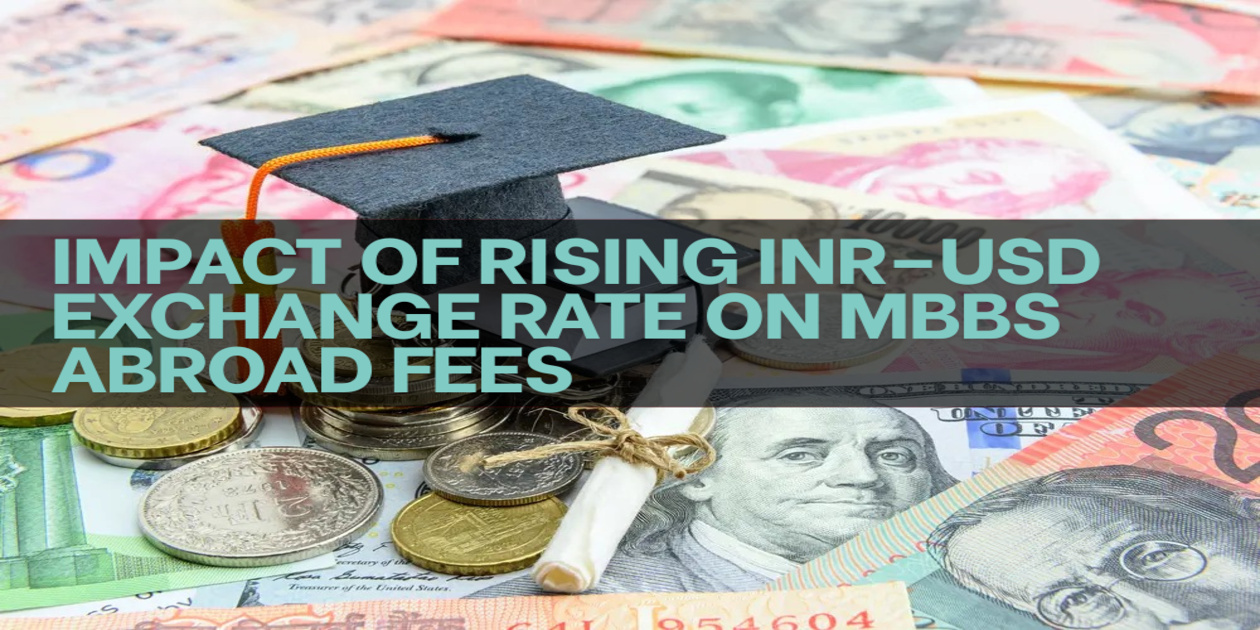
Let’s talk about something that’s quietly making life tougher for Indian students going abroad for MBBS—the rising dollar. Every year, more students pack their bags for countries like Russia, Kazakhstan, the Philippines, Georgia, and Uzbekistan. But as the value of rupee goes against the dollar, the dream gets more expensive. It’s not just tuition—living costs shoot up too, just because the currency exchange isn’t in your Favor.
Why Does the Exchange Rate Hit So Hard?
Most foreign medical universities set their fees in US dollars. Even if their local money isn’t as strong as the dollar, the bills, admission letters, and payments are almost always in USD. So, when the value of rupee drops, your cost for doing MBBS also goes up, even if the college keeps fees the same.
Here’s an example:
Say, your university’s cost $5,000 a year.
If dollar’s value is at ₹75, you pay ₹3,75,000.
If it climbs to ₹86, suddenly you’re paying ₹4,30,000.
That’s ₹55,000 extra each year—just because of exchange rates. Over six years, that’s another ₹3–3.5 lakh out of your pocket, without any official fee hike.
How Do Indian Students Feel the Pinch?
- You need more money up front for admission—application, seat booking, first semester fees.
- Living expenses go up because hostels, food, insurance—everything’s linked to the dollar.
- Currency conversion and international bank transfers get pricier.
- Families feel the squeeze, especially if there’s an education loan involved.
Honestly, budgeting becomes a guessing game. What used to be a ₹25 lakh MBBS degree can suddenly cost ₹30 lakh or more.
Where’s the Dollar’s Impact Worst?
 What’s Different About Russia?
- Tuition is mostly in rubles, not dollars.
- The ruble and rupee have a steadier relationship.
- You usually pay the university directly in rubles—less headache, less dollar-dependency.
So even if the dollar’s on a rollercoaster, the cost of studying medicine in Russia barely budges. Sometimes, it doesn’t move at all.
What Does MBBS in Russia Actually Cost?
- Tuition per year: ₹2.5–5 lakh
- Six-year total: ₹18–30 lakh
- Living expenditures: ₹8,000–₹12,000 a month
-accommodation: ₹25,000–₹60,000 a year
While other countries see fees jump with the dollar, Russia stays steady. It’s one of the most predictable and affordable options out there.
Why Do Indian Students Keep Picking Russia?
What’s Different About Russia?
- Tuition is mostly in rubles, not dollars.
- The ruble and rupee have a steadier relationship.
- You usually pay the university directly in rubles—less headache, less dollar-dependency.
So even if the dollar’s on a rollercoaster, the cost of studying medicine in Russia barely budges. Sometimes, it doesn’t move at all.
What Does MBBS in Russia Actually Cost?
- Tuition per year: ₹2.5–5 lakh
- Six-year total: ₹18–30 lakh
- Living expenditures: ₹8,000–₹12,000 a month
-accommodation: ₹25,000–₹60,000 a year
While other countries see fees jump with the dollar, Russia stays steady. It’s one of the most predictable and affordable options out there.
Why Do Indian Students Keep Picking Russia?
- Philippines – Most expenses, from tuition to daily living, are pegged to the dollar.
- USA / Caribbean universities – Everything runs on USD.
- Georgia – Even though the official money is GEL, USD still calls the shots when it comes to fees.
- Uzbekistan & Kazakhstan – Their local currencies keep dancing to the dollar’s tune.
What’s Different About Russia?
- Tuition is mostly in rubles, not dollars.
- The ruble and rupee have a steadier relationship.
- You usually pay the university directly in rubles—less headache, less dollar-dependency.
So even if the dollar’s on a rollercoaster, the cost of studying medicine in Russia barely budges. Sometimes, it doesn’t move at all.
What Does MBBS in Russia Actually Cost?
- Tuition per year: ₹2.5–5 lakh
- Six-year total: ₹18–30 lakh
- Living expenditures: ₹8,000–₹12,000 a month
-accommodation: ₹25,000–₹60,000 a year
While other countries see fees jump with the dollar, Russia stays steady. It’s one of the most predictable and affordable options out there.
Why Do Indian Students Keep Picking Russia?
- World-Class Medical Universities
- Real-World Training
- Safe and Welcoming
- English-Medium Courses
- Affordable Living